
MSO vs LCO: Understanding How India's Cable TV Network Works
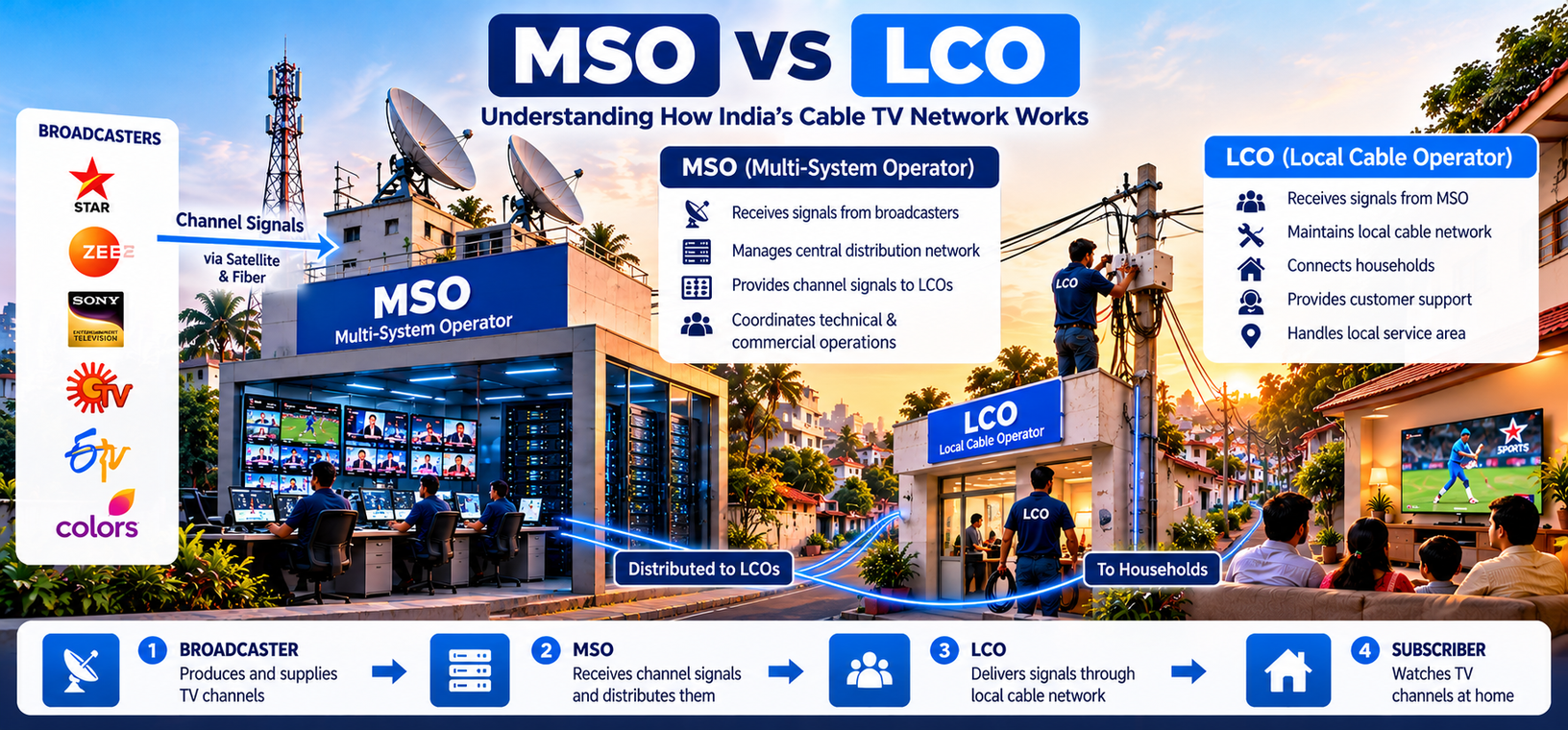
Learn the difference between Multi-System Operators (MSOs) and Local Cable Operators (LCOs), how they work together to deliver cable television, their responsibilities in the distribution chain and why their partnership matters to India's regional cable TV industry.
MSO vs LCO: Understanding How India's Cable TV Network Works
Introduction
When viewers switch on their television and browse through news, entertainment, sports and regional channels, they rarely think about the network that delivers those programmes to their homes. Behind a conventional cable TV connection is a distribution system involving broadcasters, Multi-System Operators (MSOs), Local Cable Operators (LCOs) and the infrastructure connecting them.
Each participant has a different role in delivering television services. Understanding these roles helps explain how cable TV businesses operate, how regional networks reach households and why cooperation between network operators and local service providers is important. For businesses involved in cable television, including regional networks such as BCN Digital, the MSO–LCO relationship is an important part of the industry's operating model.
What Is an MSO (Multi-System Operator)?
A Multi-System Operator, commonly known as an MSO, is a cable television distribution business that receives television signals from broadcasters and distributes them to households directly or through Local Cable Operators.
According to India's Ministry of Information and Broadcasting, MSOs operate under the Cable Television Networks (Regulation) Act, 1995 and the applicable rules. They form an important part of the distribution chain between broadcasters and cable TV subscribers.
An MSO may manage centralised distribution infrastructure, coordinate channel delivery, establish commercial arrangements with LCOs and support the systems required to provide television services across its network.
Depending on its operating model, an MSO may serve customers directly in some locations while working with local operators in others.
Typical MSO responsibilities include:
Receiving and distributing television signals from broadcasters.
Managing the central distribution infrastructure and related technical systems.
Providing channel signals to associated LCOs under applicable agreements.
Coordinating channel availability, technical changes and network upgrades.
Managing commercial relationships with local operators.
Meeting applicable registration, regulatory and service obligations.
The scale of an MSO's operations can vary. Some focus on particular regions, while others operate across multiple districts or states.
What Is an LCO (Local Cable Operator)?
A Local Cable Operator, or LCO, is the service provider responsible for delivering cable television to customers in a specific locality or service area. LCOs commonly receive channel signals from an MSO and distribute them to connected households through the local cable network.
The Ministry of Information and Broadcasting identifies LCOs as last-mile operators that transmit signals to consumer households and interact directly with customers.
Because LCOs work close to their customers, they often understand local requirements, installation conditions and common service issues. This local presence makes them an important part of the cable television ecosystem.
Typical LCO responsibilities may include:
Connecting households to the cable network.
Arranging customer installations and service visits.
Maintaining or coordinating maintenance of local distribution lines.
Helping customers with routine connection and equipment issues.
Communicating service updates and package information.
Coordinating with the MSO when signal or distribution problems require wider technical support.
The precise division of responsibilities depends on the network structure, commercial agreement and applicable regulations.
MSO vs LCO: What Is the Difference?
Although MSOs and LCOs work towards the same outcome—delivering television services—their roles differ in scope.
Area MSO LCO Main role Central or wider network distribution Last-mile delivery to customers Typical coverage Multiple localities, towns or districts A local service area Signal delivery Receives signals from broadcasters and supplies them through its distribution network Receives signals from an MSO and distributes them to households Infrastructure Manages central distribution systems and relevant network infrastructure Manages or coordinates local connections and last-mile infrastructure Customer interaction May serve customers directly and coordinate with LCOs Usually has direct contact with local subscribers Technical coordination Handles network-level issues within its responsibility Identifies local issues and escalates wider network faults Business relationships Establishes arrangements with LCOs and other relevant parties Works with the MSO under the applicable commercial agreement
These are general industry distinctions rather than a universal allocation of every task. Actual responsibilities can differ between operators and agreements.
How an MSO and LCO Work Together
The cable TV distribution process can be understood as a sequence of connected activities. A broadcaster produces or supplies a television channel, a distribution network receives and carries its signal, and the service reaches a household through the relevant delivery infrastructure.
A typical cable TV distribution chain works as follows:
Broadcaster: Supplies a permitted television channel and its programming.
MSO: Receives the channel signal and distributes it through its network.
LCO: Receives the relevant signals from the MSO and delivers them through the local cable network.
Subscriber: Watches the available channels using compatible television equipment and any required set-top box.
This is a simplified model; some MSOs serve subscribers directly, and the technical route may vary depending on the network architecture.
For the relationship to work effectively, the MSO and LCO need clear arrangements for signal availability, channel packages, commercial settlements, equipment, fault reporting and customer support.
For example, if a problem affects a large part of the distribution network, the MSO may need to investigate the central signal or infrastructure. If a problem affects only one household, the LCO may first check the local connection or customer equipment.
Good coordination helps identify the source of a problem without unnecessary delays.
How Revenue and Commercial Arrangements Work
The MSO–LCO relationship is also a business partnership. Both parties have operating costs and responsibilities, and their commercial agreement determines how they work together.
Depending on the agreement and applicable regulations, commercial matters may include channel distribution charges, subscriber-related payments, equipment arrangements, network maintenance and settlement procedures.
An MSO needs to manage the costs of its distribution infrastructure, technical systems and relevant business operations. An LCO needs to account for local network costs, customer connections, field support and other responsibilities assigned to it.
Clear agreements can reduce disputes by defining payment terms, service expectations, responsibilities for equipment and procedures for resolving disagreements.
There is no single revenue-sharing formula that applies to every MSO–LCO relationship. The arrangement depends on the parties' agreement, the applicable regulatory framework and the services being provided.
Why the MSO–LCO Partnership Matters
A cable television network depends on more than the availability of channel signals. It also needs a practical way to connect households, respond to service issues and maintain the infrastructure used to deliver television.
MSOs provide the wider distribution framework, while LCOs contribute local reach and direct customer interaction. When both sides coordinate effectively, they can support service continuity and extend coverage to more households.
This partnership is particularly relevant in regional markets, where local operators may have established relationships with residents and a detailed understanding of the areas they serve.
For customers, the value of this model is reflected in practical outcomes: a working connection, access to the subscribed channels, clear service information and assistance when problems occur.
Regulatory Responsibilities in India's Cable TV Industry
Cable television operations in India are governed by the Cable Television Networks (Regulation) Act, 1995 and the rules and amendments applicable to the service and operator category.
Registration requirements apply to cable operators. The Ministry of Information and Broadcasting oversees MSO registration and, following amendments introduced in January 2025, also handles LCO registration through an online process. The amendments made LCO registration valid for five years and provided for registration across the territory of India, subject to the applicable rules and conditions.
Operators should consult the current Ministry requirements before starting or renewing operations, as regulatory procedures and obligations can change. Compliance is relevant to both sides of the distribution relationship. Businesses need to understand their registration status, applicable agreements and responsibilities rather than relying only on customary local practices.
Official information is available through the Ministry of Information and Broadcasting and the Broadcast Seva portal.
The Role of MSOs and LCOs in Regional Networks
Regional cable networks depend on coordination between central distribution systems and local service providers. An MSO can build the distribution capability needed to supply television signals across multiple locations, while LCOs help make those services accessible to individual households.
This structure can support growth without requiring one central organisation to manage every customer-facing activity directly. However, expansion also increases the need for communication, technical support and clearly defined responsibilities.
For regional businesses such as BCN Digital, understanding the MSO–LCO relationship provides useful context for how cable television distribution works across towns and districts. It also helps explain why local operator partnerships are significant to the industry's wider operating model.
How Cable TV Distribution Is Changing
The television industry now includes conventional cable TV, direct-to-home services, IPTV and internet-based streaming platforms. These services use different distribution methods, although some businesses operate across more than one part of the entertainment ecosystem.
Cable operators are also exploring ways to use existing infrastructure more effectively. In September 2023, the Ministry of Information and Broadcasting announced amendments enabling infrastructure sharing by cable operators with broadband service providers to support wider internet access.
This creates potential opportunities for businesses with suitable infrastructure and capabilities, but cable TV and broadband remain different services with different technical and operational requirements.
As viewing habits change, MSOs and LCOs need to understand both their existing responsibilities and the opportunities that may arise from new service models.
Final Thoughts
MSOs and LCOs perform different but complementary roles in India's cable television industry. MSOs manage wider signal distribution and related systems, while LCOs provide the local connections and customer interaction that help deliver television to households.
The effectiveness of the relationship depends on clear commercial agreements, coordinated technical support, appropriate infrastructure and compliance with applicable regulations.
Understanding this model provides a foundation for examining how regional cable businesses operate and how they can respond to changes in television and broadband services. It also sets the context for the next stage of the company evolution series: the development of broadband services following the cable TV business.
Explore Our Plans